simpleLOMs
Lumped oscillator models for superconducting quantum circuits.
The simpleLOMs package allows you to quickly generate lumped oscillator models of distributed resonators, and directly integrate them into your circuit design.
Functionality
Lumped oscillator models
The simpleLOMs package provides a single interface to three different lumped oscillator models (LOMs) of a coplanar-waveguide (CPW) resonator. The optimized method is the default method and is the most accurate, as it accounts for the loading on both ends of the resonator. The other two methods are faster but less accurate, and are provided for comparison and convenience.
Every lumped model is fit through the same fit_lom() call and returns
an effective (L, C) you can reuse across a coupling sweep:
Optimized — loading-aware and most accurate
Foster — a simple closed form expression commonly used in Black Box Quantization
Analytical — a closed form expression relying on the bare resonance $f_0$
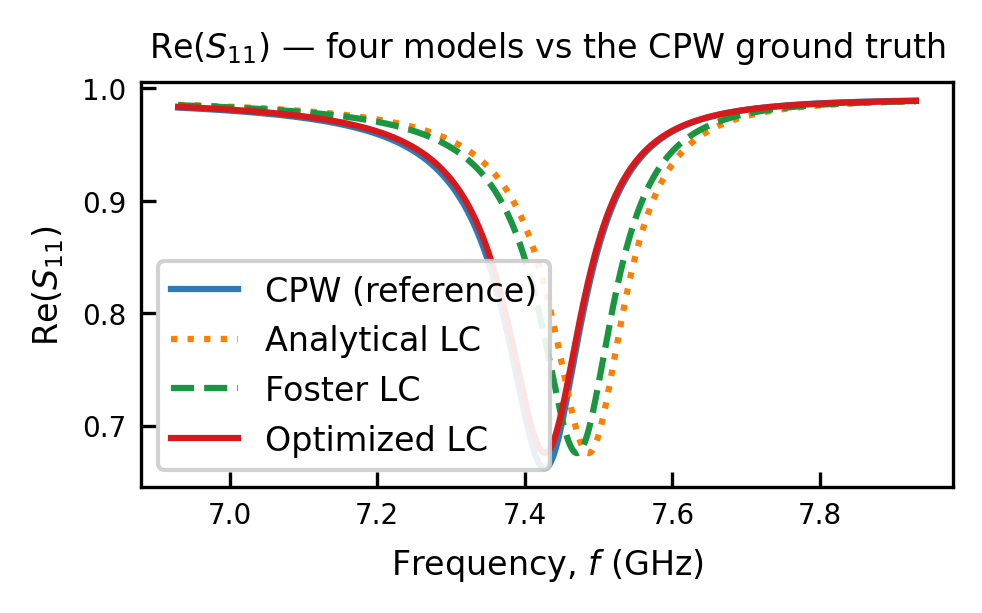
Transmission through a strongly asymmetrically coupled resonator. The optimized LOM sits on top of the full-wave reference, while the closed-form estimate is off by roughly 0.75 GHz, as described in Tutorial 1.
You can create and view circuit-level designs, both using distributed lumped elements and using schematics both of the modular lumped designs.
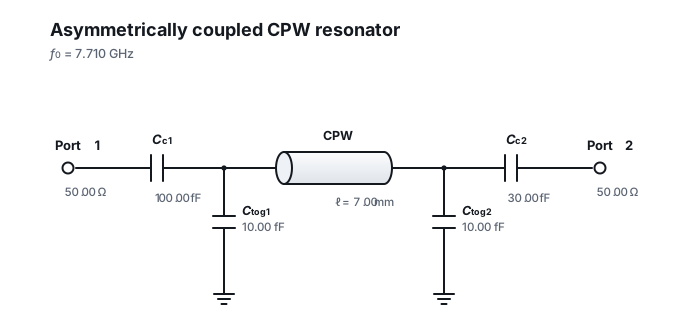
A CPW resonator reduced to lumped elements made using the simpleLOMs schematic feature. Learn how to do this for
Modular network design
Larger networks can also be split into subsystems containing a single distributed element and analyzed. Optimized lumped models can be fit to individual elements in a larger network, and then recombined to form a complete network model.
This allows you to quickly analyze large networks of resonators without having to fit the entire network at once.
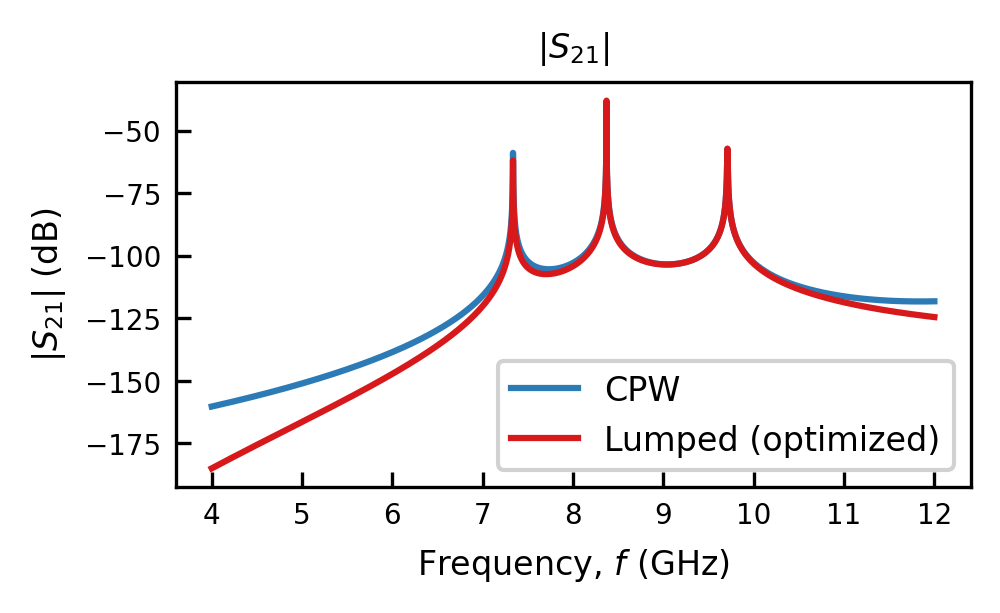
Fit of a network containing three distributed resonators, as described in Tutorial 3.
These larger networks can also be easily visualized and exported to a schematic representation, with the fitted lumped element models replacing the distributed elements.
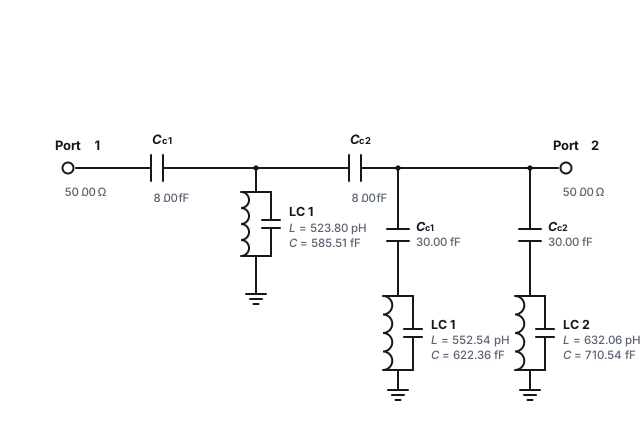
Fitted lumped element models of a network containing both inline and hanging resonators, as described in Tutorial 9.
Design optimization
simpleLOMs also provides a simple interface to optimize the design of a resonator to hit a target frequency and loaded quality factor using circuit-level models. This is done by sweeping the resonator length and coupling capacitance, as described in Tutorial 7.
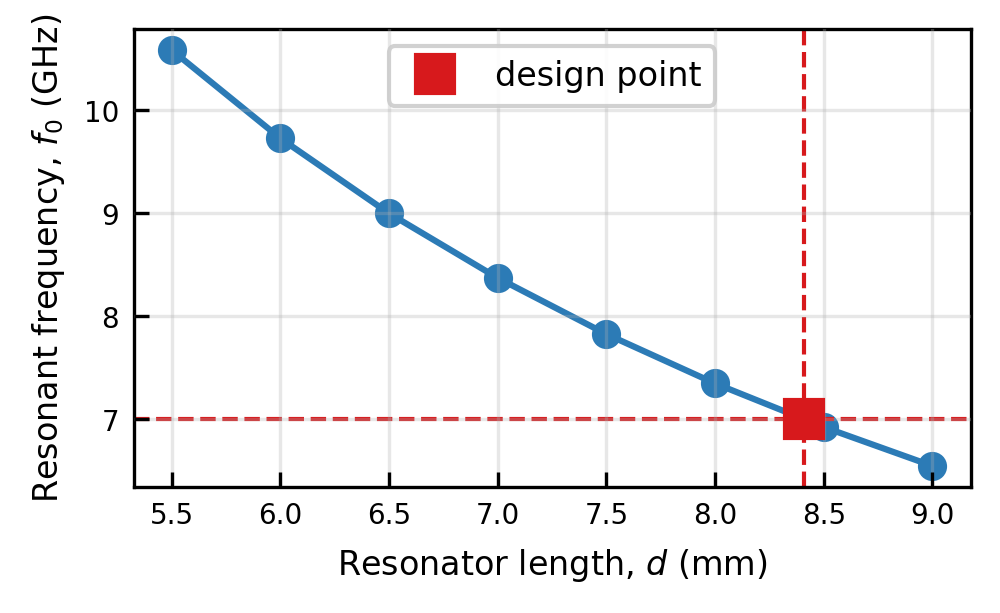
Resonant frequency versus resonator length. The design point marks the length chosen to hit a target frequency of 7 GHz, as described in Tutorial 7.
Integration with FEM and Touchstone files
The simpleLOMs package uses scikitrf which can natively read Touchstone files generated from full-wave simulations or measurement. This allows you to compare and quickly validate the lumped oscillator models against full-wave simulations or measured data.
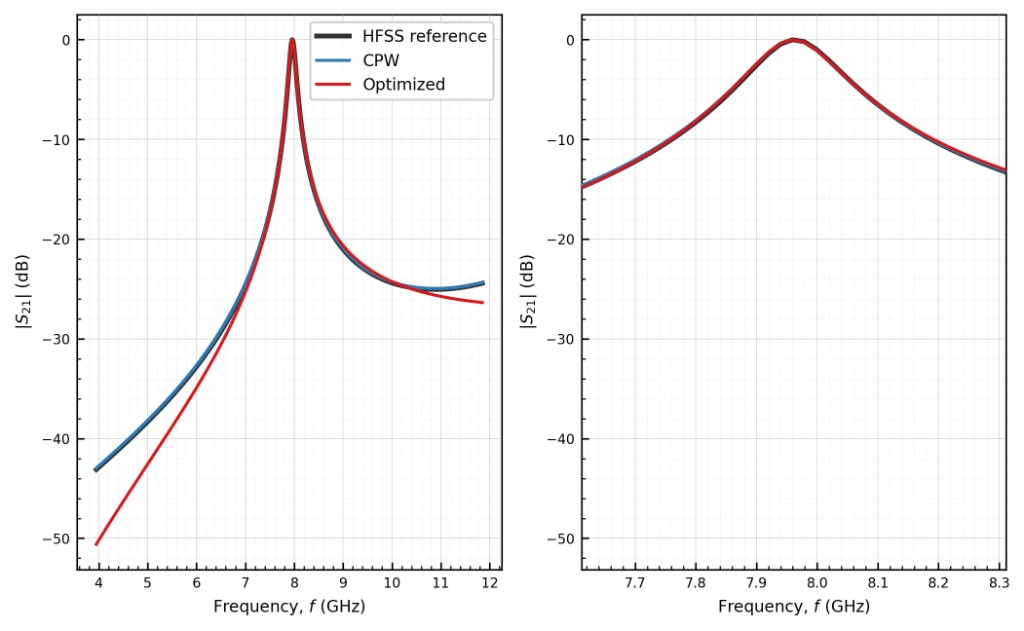
Comparison of a lumped oscillator model against a full-wave simulation, generated using ANSYS HFSS, as shown in Tutorial 5.
Citation
If you use simpleLOMs in your research, please cite:
Elizabeth Kunz and Eli Levenson-Falk, Simple, rapid black box quantization for superconducting quantum circuits (2026).
See Citation for BibTeX and machine-readable CITATION.cff metadata.
Quick links
Quick start
New here? Start with Installation, then walk through
Tutorial 1: Fitting LC Models to a CPW. The figures on this page are regenerated by
notebooks/generate_docs_figures.py.
import skrf as rf
from simpleLOMs import CPWParams, fit_lom

cpw  = CPWParams(ep_r=11.45)
freq = rf.Frequency(4e9, 12e9, 8001, unit="Hz")

# Effective L, C for a 7 mm resonator
L, C = fit_lom(7e-3, model="optimized",
               Cc1=100e-15, Cc2=30e-15,
               Ctog1=10e-15, Ctog2=10e-15,
               cpw_params=cpw, freq=freq)